

Inheriting a Legacy, Honoring a Voice
Mithelesh Jha carries the legacy of one of the most revered names in Indian folk art - his grandmother, the late Padma Shri Sita Devi, a pioneer of Madhubani (Mithila) painting. As one of the founding figures of the Bharni style, Sita Devi helped bring global attention to a regional art form once practiced quietly in the courtyards of Bihar. Her vertical, elongated figures and use of vivid color defined a generation of Mithila art. Growing up in her shadow, Mithelesh was immersed in a world where art was not just expression, but inheritance.
Born into the Brahmin community, traditionally associated with the Bharni style, Mithelesh was expected to follow in the stylistic footsteps of his lineage. Bharni is known for its filled-in color work and bold outlines, while Kachni - another style of Madhubani, typically practiced by non-Brahmin communities - focuses on intricate linework. Interestingly, Mithelesh blends both traditions. While he stays true to the spirit of Bharni, he is not bound by it, and incorporates the fine, detailed elements of Kachni into his work as a personal and cultural unifier.
As a child, Mithelesh watched his grandmother's artistry unfold alongside her growing acclaim. From awards to television interviews, Sita Devi’s presence filled the home with pride and purpose. Though he treasures photos and memories of her being honored by prominent cultural institutions, he chooses to keep much of that history private - quietly respectful of its weight. That sense of humility defines him. While some might lean into fame, Mithelesh leans into discipline.
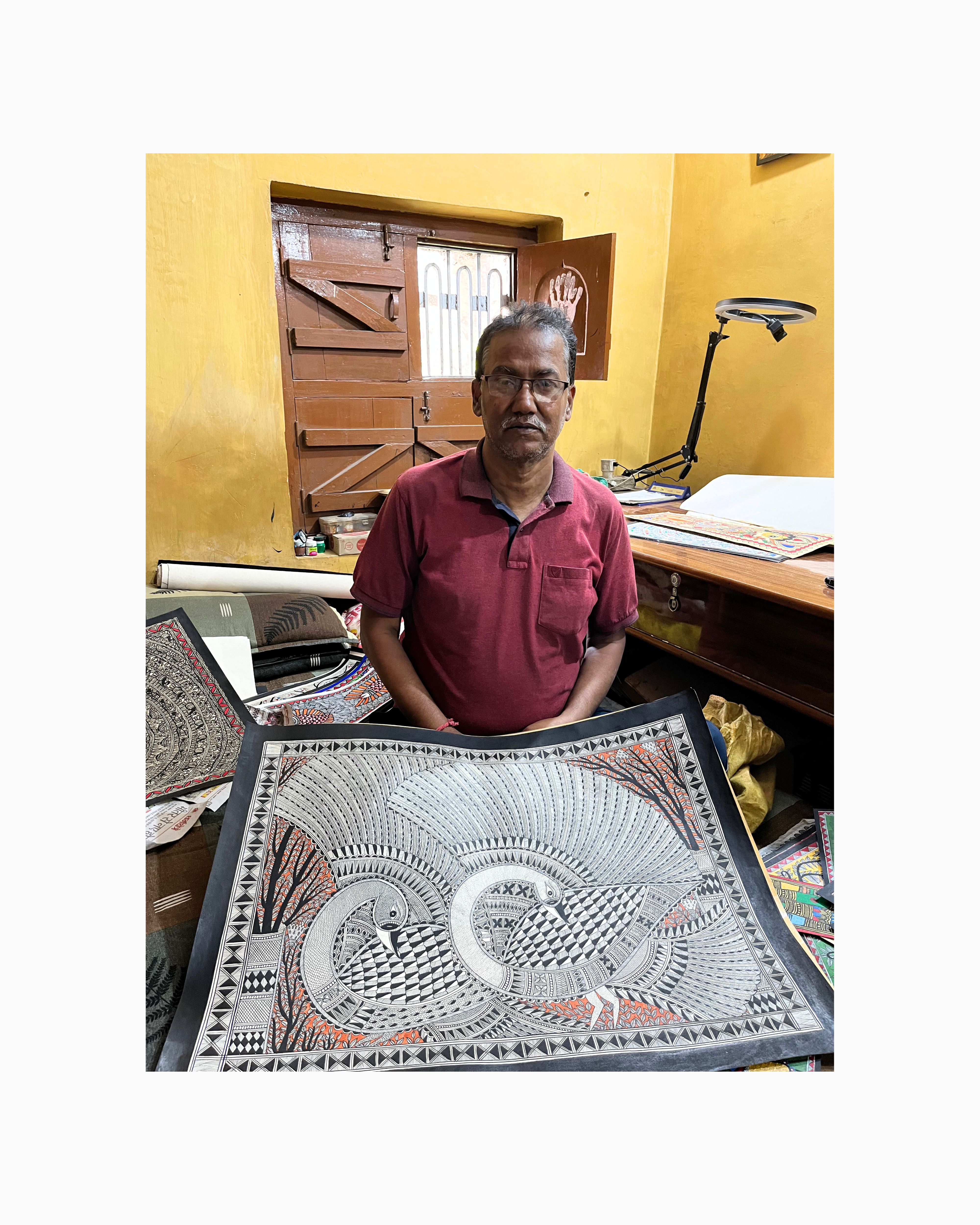
During a visit to his home, what stood out was not just the art, but the intentionality with which he works. Paintings are carefully stored by size, protected from moisture, and treated with reverence. His workspace - a quiet corner by a window - is set up to support deep concentration. When showing his work, he speaks softly, often folding each painting away as soon as it’s viewed, as if tucking away a part of himself.
His paintings are rich with detail and color, steeped in tradition yet animated by his own vision. When asked why he didn’t continue his grandmother’s exact style, he smiled and said that while he does occasionally return to it, the market - and the artist - have changed. His goal is not to imitate, but to evolve. “I’ve inherited her legacy, but my art has its own rhythm,” he explains. And indeed, that rhythm is visible in the balance between restraint and emotion in his work.
Unlike many artists who experiment with modernizing folk forms, Mithelesh prefers to remain close to the roots. He avoids over-contemporization, focusing instead on the values embedded in traditional Madhubani: symmetry, storytelling, and symbolism. Yet within that framework, he experiments with structure, layout, and mood. His works speak not only of culture, but of personal experience - of an artist who holds history in one hand and possibility in the other.
